Address
Purok 6, Tanza – Trece Road, Barangay De Ocampo, Trece Martires, Cavite, Philippines
Work Hours
Monday to Friday: 7AM - 7PM
Weekend: 10AM - 5PM
Address
Purok 6, Tanza – Trece Road, Barangay De Ocampo, Trece Martires, Cavite, Philippines
Work Hours
Monday to Friday: 7AM - 7PM
Weekend: 10AM - 5PM
Copyright 2015-2024. ECOPLUS. All rights reserved

 ByEcoPlus
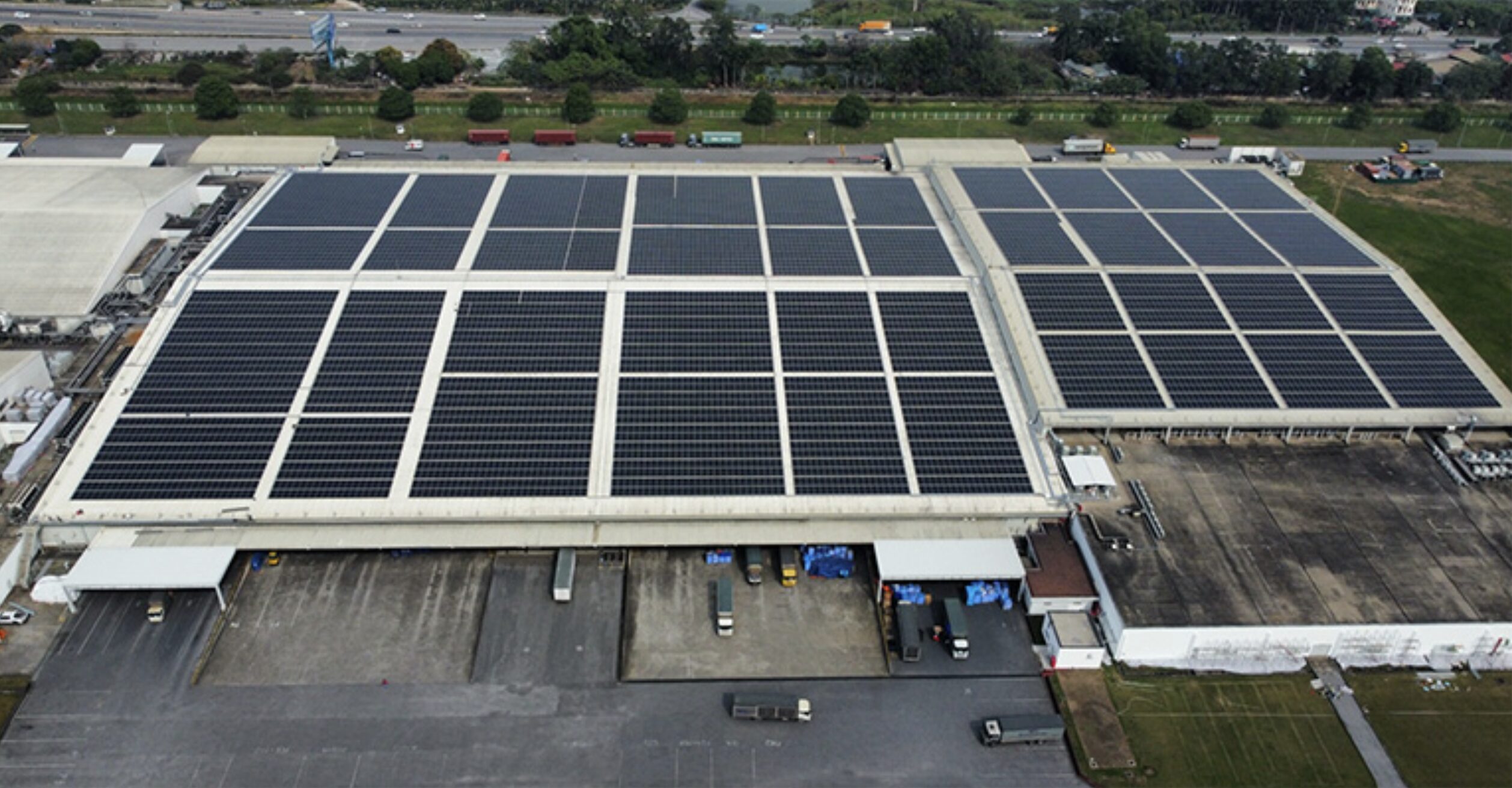
Philippine manufacturing plants and logistics warehouses are among the country’s top electricity consumers — and among the businesses hit hardest when Meralco and other distribution utilities raise their rates. With industrial electricity now costing between ₱12 and ₱15 per kWh, a single 10,000 sqm production floor can easily spend ₱500,000 to ₱2,000,000 every month just keeping the lights on and the machines running.
Solar energy is no longer an experiment in the Philippines — it is an established, commercially proven solution for industrial facilities. Ecoplus Solar has designed and built commercial and industrial solar systems across Cavite, Metro Manila, Laguna, Batangas, Rizal, Pampanga, Ilocos Sur, Leyte, and Quezon Province. Our most recent project: a 604kW grid-tied industrial solar installation that showcases exactly what modern rooftop solar can do for Philippine manufacturing.
This guide covers everything a facility manager, plant engineer, or business owner needs to evaluate, plan, and execute a commercial solar project in the Philippines — from load analysis to net metering, ROI modeling to contractor qualification.
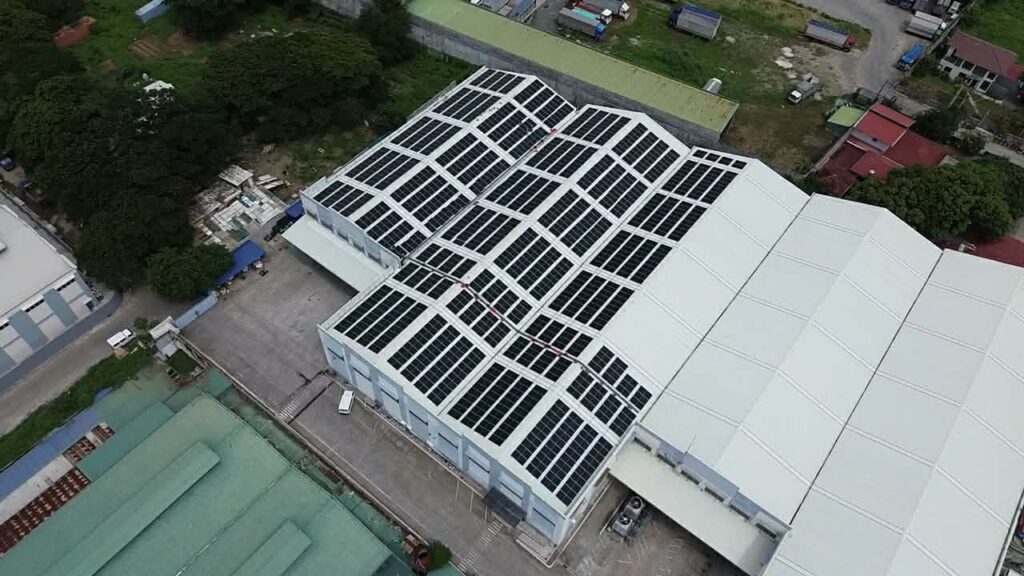
The Philippines has some of the highest commercial electricity rates in Southeast Asia. Meralco’s industrial rate schedule — applicable to most manufacturing facilities in Metro Manila, Cavite, Laguna, Batangas, and Rizal — sits between ₱12.00 and ₱15.00 per kWh when all generation, transmission, distribution, and system loss charges are included. Distribution utilities in Visayas and Mindanao (VECO, DLPC, CLPC) operate at similar or higher rates.
For a typical Philippine manufacturing plant, electricity is the second or third largest operating cost — after labor and raw materials. A light manufacturing facility running three shifts can consume 150,000 to 400,000 kWh per month. A cold storage or food processing plant with heavy refrigeration and processing loads may exceed 800,000 kWh monthly. At ₱13/kWh, that translates to ₱1.95M to ₱10.4M in electricity spend every 30 days.
₱12–15per kWh industrial rate (Meralco, 2026)
4–6%average annual electricity rate increase, Philippines (2018–2025)
25 yrswarranted solar panel performance life
5–7 yrstypical EPC payback period, Philippine industrial
The compounding effect of 4–6% annual rate increases makes inaction increasingly costly. A facility paying ₱1,000,000/month in electricity today will pay approximately ₱1,480,000/month in five years and ₱2,190,000/month in ten years — assuming a conservative 4% annual increase. Solar, once installed, locks in your generation cost at near-zero for 25 years.
Beyond the financial case, Philippine manufacturers with export operations face increasing ESG scrutiny from international buyers and auditors. Solar energy directly contributes to Scope 2 greenhouse gas emissions reduction, supporting SEC-listed and export-oriented companies in meeting sustainability reporting requirements under the SEC Sustainability Reporting Guidelines and PSE ESG Reporting Framework.
Almost all commercial and industrial solar installations in the Philippines are grid-tied systems — meaning the solar array connects to both your internal facility power system and the distribution utility’s grid simultaneously. This is distinct from off-grid solar (which requires battery storage and disconnects from the utility) and is the configuration Ecoplus Solar recommends and installs for manufacturing and warehouse clients.
During daylight hours, the solar array generates DC electricity which is converted to AC by commercial-grade string inverters or central inverters (Ecoplus Solar uses Huawei FusionSolar inverters, warranted to 10 years). This AC output is fed directly into your facility’s main distribution panel, reducing or eliminating the electricity your facility draws from the utility grid in real time.
When solar generation exceeds your facility’s instantaneous load — common during midday breaks or weekend shutdowns — surplus electricity flows back to the grid. Under DOE Department Circular DC2013-05-0009 (Net Metering Rules), your utility credits this exported energy against your next billing period’s consumption. At night or during cloudy weather, your facility draws from the grid as normal, but your monthly bill reflects only the net difference between what you consumed and what you exported.
The result: a manufacturing plant that installs a properly sized grid-tied solar system can offset 40% to 100% of its daytime electricity consumption, depending on roof area, system size, load profile, and production schedule.
| Component | Function | Typical Spec (Industrial Scale) |
|---|---|---|
| Monocrystalline Solar Panels | Convert sunlight to DC electricity | 540W–600W per panel; 25-year linear power warranty |
| String / Central Inverters | Convert DC to grid-compatible AC | Huawei FusionSolar SUN2000 series; 50–100 kW per inverter |
| Mounting Structure | Secure panels to roof; resist typhoon loads | Hot-dip galvanized or aluminum; designed for 250 kph wind |
| DC/AC Cabling | Carry power from panels to inverters to switchboard | TÜV-certified solar DC cable; THHN copper AC wiring |
| Protection & Monitoring | Surge protection, isolation, real-time monitoring | SPD, MCCB, AC combiner; Huawei FusionSolar app |
| Net Metering Meter | Bidirectional meter for utility billing | Installed and programmed by distribution utility |
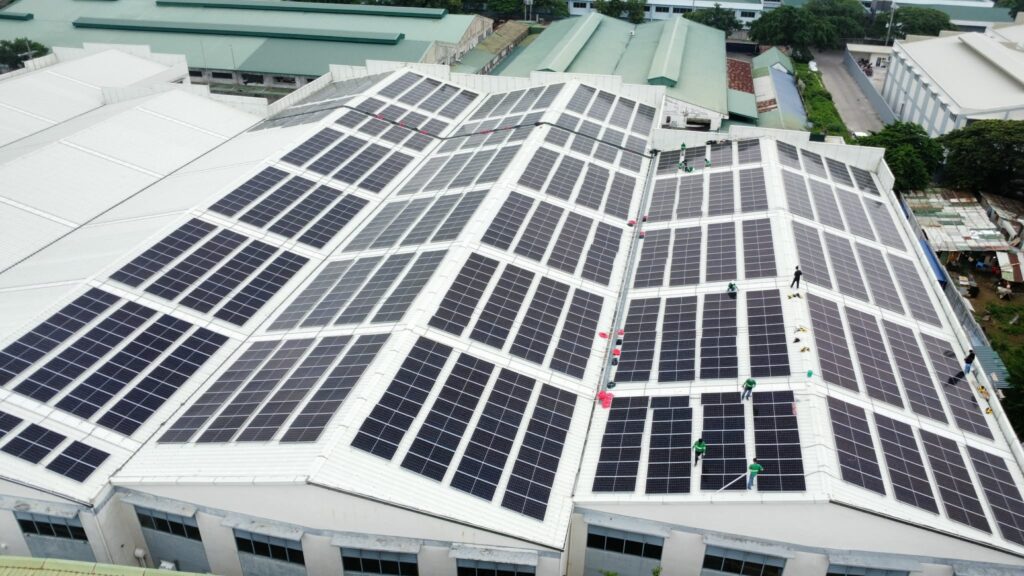
The most effective way to understand what industrial solar looks like in practice is to walk through a real project. Ecoplus Solar recently completed — and is currently commissioning — a 604kW grid-tied rooftop solar installation for a Philippine manufacturing and warehousing facility. Here is what that project involves.
Ecoplus Solar — Ongoing Commercial Installation, Philippines 2026
604 kWpTotal System Capacity
~1,100+Solar Panels Installed
~81,500 kWhEst. Monthly Generation
~977,000 kWhEst. Annual Generation
~₱1.0M+Est. Monthly Savings
Grid-TiedSystem Type (Net Metering)
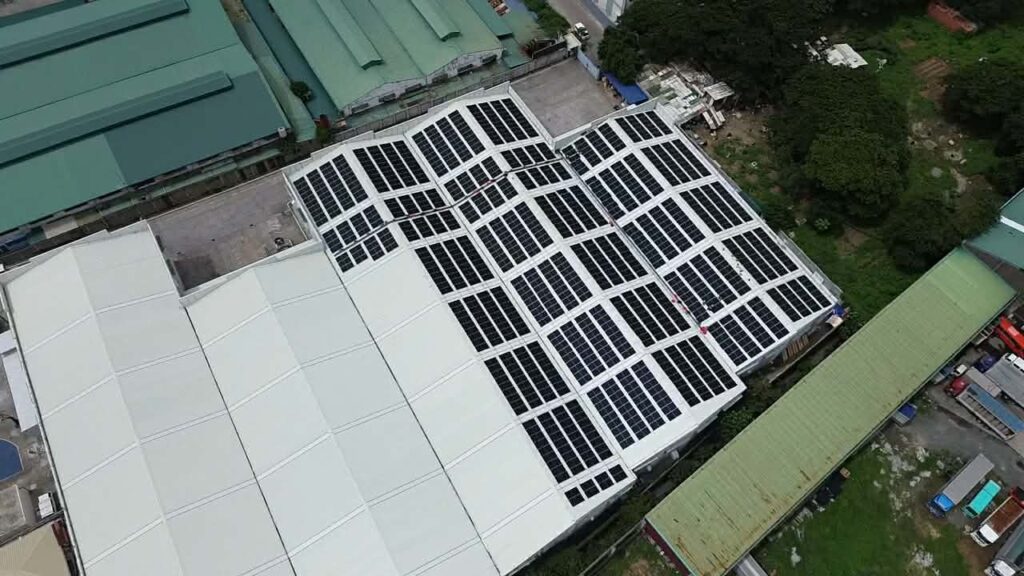
The 604kW project covers the full rooftop of a large industrial warehouse complex. Over 1,100 high-efficiency monocrystalline panels are mounted on a custom hot-dip galvanized steel racking system engineered for the Philippine typhoon zone — designed to withstand sustained winds of at least 250 kph in compliance with the Philippine Electrical Code (PEC) and NSCP structural load requirements.
Multiple Huawei FusionSolar commercial inverters distribute the load across the roof sections, with a centralized monitoring system feeding real-time generation data to the plant manager’s dashboard via the FusionSolar mobile application. The system includes surge protection devices (SPD) at both the DC and AC sides, molded-case circuit breakers (MCCB) for isolation, and a bidirectional metering point for net metering enrollment with the local distribution utility.
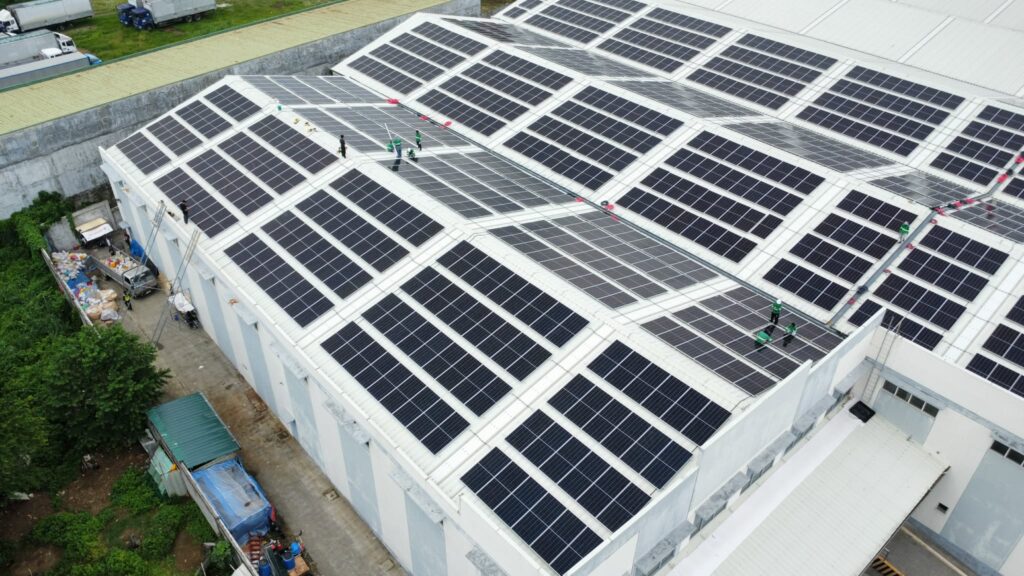
Based on the Philippine Solar Radiation Atlas data for this facility’s region — averaging 4.5 peak sun hours per day — the 604kW system is projected to generate approximately 81,500 kWh per month and 977,000 kWh per year. This assumes standard industry derating factors for temperature (module temperature coefficient), wiring losses, inverter efficiency, and system availability.
At Meralco’s current blended commercial rate of approximately ₱13.00/kWh (inclusive of all charges), this translates to estimated monthly electricity savings of over ₱1,000,000 and cumulative savings exceeding ₱300,000,000 over the system’s 25-year warrantied life — before accounting for the projected 4–6% annual rate escalation that would push actual savings significantly higher.
Almost every Philippine manufacturing plant and logistics warehouse qualifies for solar — but the right system size depends on two primary constraints: your electricity consumption profile and your available roof area. Here is how to quickly assess your facility before requesting a formal site survey.
Bill Threshold Guide — EPC vs PPA for Philippine Industrial Facilities
Monthly Bill
Recommended Path
Estimated System Size
Below ₱50,000
SME / SME+ EPC
30–80 kWp
₱50,000 – ₱100,000
Commercial EPC
80–200 kWp
₱100,000 – ₱500,000
Industrial EPC ✓ Best fit
200–800 kWp
₱500,000 and above
PPA (₱0 capital) ✓ Best fit
500 kWp – 5 MWp
A useful rule of thumb for Philippine industrial rooftops: every 100 kWp of solar needs approximately 700–900 square meters of usable, unobstructed roof area. “Usable” excludes ridge lines, skylights, ventilation equipment, water tanks, setback areas near roof edges (for fire access and structural reasons), and heavily shaded zones caused by neighboring buildings or rooftop structures.
For the 604kW project profiled above, the roof covers approximately 5,000+ sqm of usable surface. Most Philippine manufacturing warehouses in the 3,000–10,000 sqm building footprint range have sufficient roof area to install 300–1,000+ kWp of solar.
Solar panel arrays add approximately 12–18 kg per square meter of dead load to the roof structure. For existing metal-deck warehouses built to NSCP standards, this is generally within the design load margin. For older structures or those not engineered to modern code, Ecoplus Solar’s structural engineering team will conduct a load assessment and, if necessary, specify local reinforcement of purlin or rafter connections before installation proceeds.
See also: What Are the Roof Requirements for Solar Panel Installation in the Philippines?
Philippine businesses going solar today have two primary contract structures to choose from. The right choice depends primarily on your monthly electricity bill, your organization’s capital position, and your preference for asset ownership.
EPC (Engineering, Procurement, Construction) — You pay upfront (or via bank financing) and own the system. Best for facilities with monthly bills of ₱100,000–₱500,000 and access to capital or institutional financing (BDO, BPI, Metrobank solar loan programs). Full savings from Day 1. Payback typically 5–7 years.
PPA (Power Purchase Agreement) — Ecoplus Solar and Sunwell Energy Corporation own, install, and maintain the system at zero capital cost to you. You simply buy the solar electricity at a fixed rate below your current utility tariff. Best for facilities with monthly bills of ₱500,000 or more. No CAPEX, no maintenance responsibility, guaranteed savings from Day 1.
For a detailed side-by-side comparison of EPC and PPA solar contracts in the Philippines — including an ESG analysis, net metering implications, and a cost modeling table — read our full guide: EPC vs PPA: Which Solar Contract Is Right for Your Business in the Philippines?
Net metering is the billing arrangement that makes grid-tied solar financially viable for most Philippine industrial clients. Under DOE regulations, your distribution utility is required to install a bidirectional meter and credit any solar electricity you export to the grid against your future consumption — at the same rate you pay to buy electricity.
The standard net metering provision applies to systems up to 100 kWp. For larger industrial systems (like the 604kW project above), Ecoplus Solar structures the installation as multiple sub-systems — each separately metered — or works with the client’s distribution utility on appropriate interconnection agreements for large commercial generators.
Total timeline from contract signing to net metering energization: typically 60–90 days for systems in the 200–600 kWp range, subject to utility processing times and LGU permit schedules.
The financial case for industrial solar in the Philippines is strong and improving year on year as electricity rates continue to rise. The table below models the expected savings and payback for systems at three common industrial scales, using conservative assumptions.
| Scenario | 200 kWp System | 604 kWp System | 1,000 kWp System |
|---|---|---|---|
| Estimated CAPEX (EPC) | ₱9.2M – ₱11M | ₱27.8M – ₱33.2M | ₱45M – ₱55M |
| Monthly Generation | ~27,000 kWh | ~81,540 kWh | ~135,000 kWh |
| Monthly Savings (at ₱13/kWh) | ~₱351,000 | ~₱1,060,000 | ~₱1,755,000 |
| Annual Savings | ~₱4.2M | ~₱12.7M | ~₱21.1M |
| Simple Payback (EPC) | ~2.2 – 2.6 yrs | ~2.2 – 2.6 yrs | ~2.1 – 2.6 yrs |
| 25-Year Cumulative Savings | ~₱105M | ~₱318M | ~₱527M |
| PPA Option Available? | No (below threshold) | ✅ Yes (₱0 capital) | ✅ Yes (₱0 capital) |
| Equivalent Monthly Bills Eliminated | ~27,000 kWh worth | ~81,500 kWh worth | ~135,000 kWh worth |
Note: Savings projections use ₱13/kWh blended rate and 4.5 peak sun hours/day. Actual savings will vary based on your specific utility rate schedule, load profile, net metering credit utilization, and annual rate escalation. Payback periods assume self-financing; bank-financed projects have different cash flow profiles. Ecoplus Solar provides a detailed financial model specific to your facility as part of the free site assessment process.
For more on long-term financial performance: How Much Money Can You Save by Going Solar in the Long Term?
Choosing a solar contractor for a ₱10M–₱50M+ industrial project is a long-term commitment. The panels and inverters will be on your roof for 25 years; the contractor you choose should still be in business and equipped to service your system in Year 10 and Year 20. Here is what distinguishes Ecoplus Solar in the Philippine industrial market.
DOE and PCAB Accreditation. Ecoplus Solar holds DOE Solar PV Accreditation No. DOE-SPV-1023-0015 and PCAB License No. 60345. These are not optional: DOE accreditation is a legal requirement for commercial solar installation in the Philippines, and PCAB licensing is required for all electrical and civil works covered under the Solar EPC contract. Verify any solar contractor’s credentials at pcab.gov.ph before signing.
Huawei FusionSolar Certified Installer. Ecoplus Solar is a recognized Huawei FusionSolar installer and recipient of the Huawei Outstanding Installer Award — one of the highest distinctions available to solar installers in Southeast Asia. This certification means our engineers have completed Huawei’s technical training program and our installations meet Huawei’s stringent quality benchmarks for inverter installation, string configuration, and monitoring setup.
In-House Engineering Team. Unlike many solar resellers who subcontract all technical work, Ecoplus Solar maintains a full in-house engineering team for structural analysis, electrical design, PV system modeling, and permitting. This means faster project timelines, single-point accountability, and no margin markups from subcontractors.
PPA Partnership with Sunwell Energy Corporation. For facilities with monthly electricity bills exceeding ₱500,000, Ecoplus Solar offers a zero-capital PPA option in partnership with Sunwell Energy Corporation — one of the Philippines’ established renewable energy developers. Your facility gets solar at no upfront cost; Sunwell and Ecoplus own and maintain the system; you pay only for the solar electricity you consume, at a rate below your utility tariff.
National Coverage, Regional Expertise. Ecoplus Solar has completed commercial and industrial projects in Cavite, Metro Manila, Laguna, Batangas, Rizal, Pampanga, Ilocos Sur, Leyte, and Quezon Province. We understand the specific permitting requirements, utility interconnection processes, and structural conditions across Philippine regions — including the higher wind load design requirements in typhoon-prone provinces.
A commercial or industrial solar system typically costs between ₱40,000 and ₱55,000 per kWp installed under an EPC contract. A 100kWp system ranges from ₱4M to ₱5.5M; a 604kWp system like the Ecoplus Solar project profiled here ranges from ₱27M to ₱33M. Facilities with monthly bills of ₱500,000 or more may qualify for a PPA (Power Purchase Agreement) at zero capital outlay through Ecoplus Solar and Sunwell Energy Corporation.
System size depends on your facility’s monthly kWh consumption and available roof area. Every 1 kWp of solar generates approximately 120–135 kWh per month in the Philippines (4.0–4.5 peak sun hours daily). A plant consuming 100,000 kWh/month would need approximately 750–830 kWp. Ecoplus Solar conducts a free load analysis and site assessment to determine the exact system size for your facility.
Yes. Under DOE Department Circular DC2013-05-0009 and the Renewable Energy Act of 2008 (RA 9513), commercial and industrial facilities can apply for net metering with their distribution utility. The standard provision covers systems up to 100 kWp; larger industrial systems use sub-metering arrangements or direct interconnection agreements. Ecoplus Solar handles the complete net metering application process with Meralco, DLPC, CLPC, and other utilities.
A well-designed industrial solar system in the Philippines typically achieves full payback in 5 to 7 years under an EPC contract. At Meralco’s current industrial rate of approximately ₱12–₱14 per kWh, a 604kWp system can save over ₱1,000,000 per month in electricity costs, yielding over ₱300M in cumulative savings over a 25-year system life. Under a PPA contract, savings begin immediately with no capital investment.
A 500kWp–1MWp industrial solar installation typically takes 60 to 90 days from contract signing to energization. The timeline includes engineering design (2–3 weeks), procurement (3–4 weeks), physical installation (2–4 weeks), and grid connection / DOE and utility inspection (1–2 weeks). Ecoplus Solar manages the entire process and coordinates with the distribution utility on your behalf.
Industrial solar works best on metal corrugated roofs (spandeck, IBR profile, or pre-painted galvalume) and reinforced concrete decks — all common in Philippine manufacturing parks. As a guideline, every 100 kWp of solar needs approximately 700–900 sqm of usable roof area. A 604kWp system requires roughly 4,200–5,400 sqm of south-facing or east-west split roof surface. Ecoplus Solar’s engineering team conducts a structural load assessment before installation to confirm compatibility with your existing roof.
Yes. Ecoplus Solar holds DOE Solar PV Accreditation No. DOE-SPV-1023-0015 and PCAB License No. 60345, authorizing solar photovoltaic installation across the Philippines. The company is a certified Huawei FusionSolar installer and recipient of the Huawei Outstanding Installer Award. Ecoplus serves commercial and industrial clients across Cavite, Metro Manila, Laguna, Batangas, Rizal, Pampanga, Ilocos Sur, Leyte, and Quezon Province.
Yes. PEZA-registered enterprises may qualify for income tax holidays (ITH) and other fiscal incentives under the CREATE Act and the Renewable Energy Act of 2008, which includes a 7-year income tax holiday for RE developers and zero VAT on equipment. The specific incentives depend on your PEZA registration type, activity tier, and RE developer status. Ecoplus Solar recommends consulting a licensed tax advisor and reviewing your PEZA registration terms before finalizing your solar contract structure.
Send us your last three months of electricity bills and we will return a detailed system sizing recommendation, projected savings analysis, and timeline estimate — at no cost and no obligation.Request Free Assessment Schedule a Site Visit
Ecoplus Solar • DOE-SPV-1023-0015 • PCAB No. 60345 • Huawei FusionSolar Outstanding Installer • Serving Cavite, Metro Manila, Laguna, Batangas, Rizal, Pampanga, Ilocos Sur, Leyte, Quezon Province